Why Finding the Right Therapist Matters: OCD vs. Trauma and When They Overlap
Imagine finding a therapist you click with. They talk and talk and talk with you about the fears you have in your relationship. They ask thoughtful questions about all the possible scenarios that could go down. They even reassure you that you didn’t do anything wrong, that you deserve to be upset, or that you are a good person.
But the ruminations don’t go away when you leave their office. In fact, they may even get worse.
Sure, you connect with the therapist. They may just not be recognizing and treating Obsessive-Compulsive Disorder (OCD). They’re feeding it.
If your intrusive thoughts are repeating, spiraling, or “sticky,” the right approach matters as much as the relationship.
What is OCD?
Obsessive-Compulsive Disorder involves intrusive, unwanted thoughts, images, or urges that cause distress, followed by compulsions—mental or physical actions meant to reduce that discomfort.
The relief is temporary, which is why OCD can feel exhausting and hard to break without the right kind of support.
Temporary relief → reinforces the cycle → makes the obsessions return louder.
OCD can be misunderstood as “just anxiety” or as something you can solve by gaining certainty, insight, or reassurance.
But in OCD, reassurance and reprocessing obsessive thoughts don’t quiet them. It exacerbates the OCD cycle. Very well-meaning therapists (who are excellent at what they do in areas like treating trauma or other diagnoses) may contribute to OCD or anxiety by keeping you too comfortable.
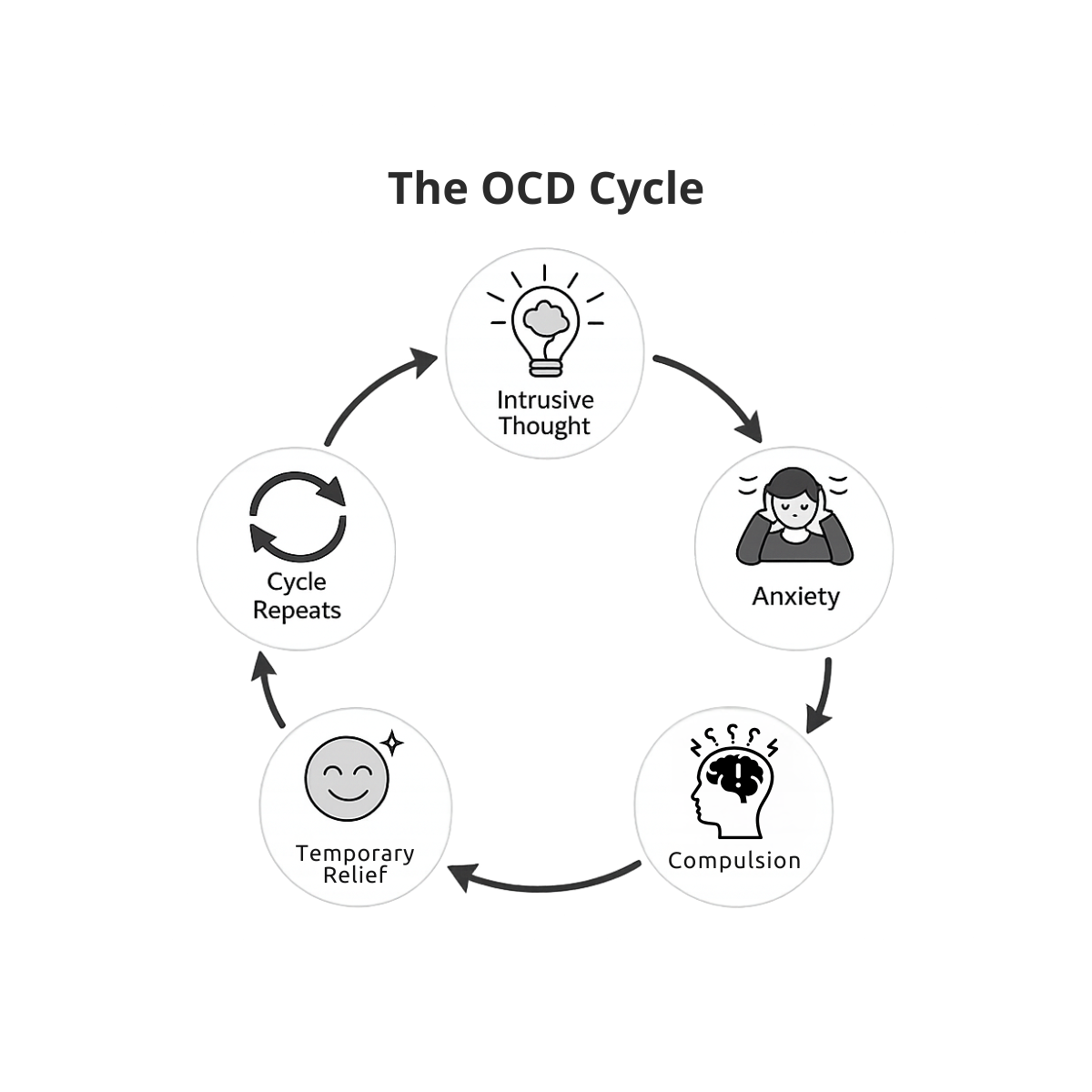
The OCD Cycle
Diagram illustrating the OCD cycle: intrusive thought, anxiety, compulsion, temporary relief, and cycle repetition.
Is CBT a good method to treat OCD?
Traditional models like general Cognitive Behavioral Therapy (CBT) can accidentally reinforce compulsions—especially when the work becomes:
“Let’s talk it through again.”
“Let’s analyze every scenario.”
“Let’s find the right answer so you can relax.”
This isn’t enough for OCD.
If you have spiraling or repeating, intrusive thoughts and compulsions, you need a therapist who understands OCD.
Evidence-Based OCD Treatment: ERP, ACT, and I-CBT
Not every (or even most) therapists understand the complexities of OCD and appropriate treatment. Specialization matters.
OCD treatment backed by research includes:
ERP (Exposure and Response Prevention)
ACT (Acceptance and Commitment Therapy)
I-CBT (Inference-based CBT) (newer modality)
What ERP and ACT Look Like in Real Life
ERP and ACT constantly present clients with opportunities to be uncomfortable while being supported in the therapeutic relationship—such as encouragement to participate in activities more aligned with your values rather than getting stuck in compulsive behaviors.
An OCD-informed therapist may notice you ruminating aloud about a relational issue and prompt an exposure—instead of helping you chase certainty.
Trauma Changes the Nervous System and Needs Its Own Expertise
If you’re also looking to heal from trauma, you need someone who specializes in OCD and trauma.
Trauma can leave the nervous system stuck in survival mode, even long after the danger has passed, affecting how safe, connected, or in control a person feels.
A trauma-informed therapist understands how to work with the body, pacing, and safety—not just the story—so healing doesn’t unintentionally re-activate harm.
OCD vs. Trauma: Similar Surface, Different Treatment
OCD and trauma sometimes look similar (anxiety, distress, avoidance) but require different treatment approaches.
When They Overlap, Stabilization Matters
Trauma processing without OCD stabilization can backfire. Jumping into EMDR too quickly with an OCD client may worsen compulsions.
You deserve care that is specialized and effective. Make sure the therapist you work with really understands OCD - not just anxiety treatment.
When OCD is active, the order of operations matters. Stabilize and treat OCD patterns so trauma work doesn’t unintentionally fuel the cycle.
Questions to Ask a Therapist Who Specializes in OCD and Trauma
If you’re looking for an OCD and trauma-informed therapist, here are questions that can help you assess fit and specialization:
What training do you have in evidence-based treatment for OCD (such as ERP or I-CBT) and trauma?
How do you approach OCD when trauma is also present?
How do you make sure treatment moves at a pace that feels safe and collaborative?
What does success or progress typically look like in your work with these concerns?
A good therapist won’t just reassure you; they’ll help you change your relationship to uncertainty and build tolerance for distress in a supported way.
The And Way Therapy Approach
It is critical that providers sequence treatment correctly when OCD and trauma co-occur.
At The And Way Therapy, we have EMDR-trained therapists skilled in addressing OCD from multiple angles (including I-CBT, ERP, and ACT) so that we can integrate an approach that is safe for you.
Schedule your FREE Consultation Here

Written by Kelsey Blahnik, LCSW-S
Kelsey Blahnik, LCSW-S, is an author, clinician, and advocate committed to bringing peace and justice into our politically divided world. With extensive experience in behavioral health, including work with substance abuse, unhoused individuals, and veterans, Kelsey has witnessed the impact of division on communities. She is the owner of a thriving online group therapy practice, The And Way Therapy, and author of the book The And Way: Assertive Peacemaking in a Divided World.
Outside the therapy room, you’ll usually find her reading, hiking, or enjoying matcha.