If I Need Help, I’ve Failed
(And Other Stories We Tell Ourselves About Mental Health Care)
For many people, the hardest part of considering therapy or medication isn’t the symptoms, it’s the belief that needing help means they’ve failed.
“Needing support means I’m not strong enough.”
“If I have to resort to mental health medication, I’ve failed.”
I hear versions of these beliefs every week.
So many clients have shared the internal conflict they carry when considering mental health support, whether that’s counseling or medication. They often arrive already wrestling with shame, self-judgment, and the fear that needing help means something is inherently wrong with them.
I want to say this clearly: these beliefs make sense.
We live in a culture that often equates strength with self-sufficiency, productivity with worth, and resilience with pushing through at all costs.
My clients are capable, high-functioning people who have managed a lot on their own for a long time. Reaching out for help can feel like betraying that identity.
You Can Be Strong and Need Support
But here’s where I offer a different framework:
You can be strong and need support.
You can have coped impressively and still be suffering.
You can value autonomy and choose medication as a tool.
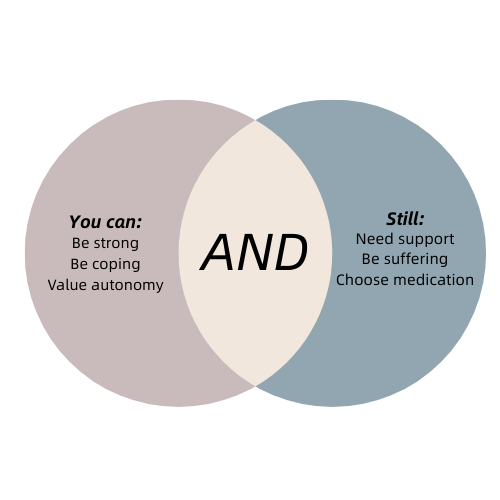
This philosophy was put into words for me when I first came across Kelsey Blahnik’s The And Way model. Early in my transition into mental health from critical care, I remember reading a line on her site that immediately resonated:
“Life isn’t about choosing between opposites. Growth happens when we hold two seemingly conflicting truths at once.” - Kelsey Blahnik
It reflected exactly what I was seeing in practice—people feeling stuck not because they lacked effort or insight, but because they believed they had to choose between false extremes: strong or struggling, independent or supported, medication or failure.
Medication Isn’t a Moral Line
This framework is foundational to how I practice psychiatry.
In my work, I don’t view mental health medication as a last resort or a moral line you cross when you’ve “failed” at coping. It’s not about numbing you or changing who you are.
It’s about taking some of the weight off—supporting your brain chemistry so you can feel more like yourself again and access the resilience that’s already there.
Mental Health Is Influenced by the Whole Picture
I also don’t believe in reducing people to diagnoses or treating symptoms in isolation.
Anxiety, depression, burnout, and emotional dysregulation don’t exist in a vacuum.
Mental health is influenced by:
Sleep
Stress
Relationships
Work demands
Physical health
Nervous system load
Past experiences
The season of life you’re in
My approach is to look at the whole picture, not just a checklist of mental health symptoms.
There Is Room for Both/And
In our work together, there is room to hold contradictory truths.
You can want to feel better and want to understand yourself more deeply.
You can try medication and prioritize therapy, lifestyle changes, and long-term wellness.
You can move forward carefully instead of rushing into a one-size-fits-all plan.
Permission to Get Help
You don’t have to prove how much you can carry alone.
You don’t have to be falling apart to deserve care.
And choosing help doesn’t mean you’ve failed.
Usually, it means you’re finally giving yourself permission to stop doing everything the hard way.
Wishing you a steady start to the new year,
Brittney Batton, Guest Author, Founder of Amplify Psychiatry and Wellness
About the Guest Author
Brittney Batton, MSN, BSN, BA, APRN, PMHNP-BC is a psychiatric nurse practitioner and the founder of Amplify Psychiatry and Wellness in Spring, Texas. She provides whole-person psychiatric care and is a supporter of Kelsey Blahnik’s The And Way model.
Learn more about Brittney and Amplify Psychiatry and Wellness here.
Want to learn more about The And Way approach?
Explore the model here and why it resonates with so many people navigating anxiety, burnout, and big life transitions.